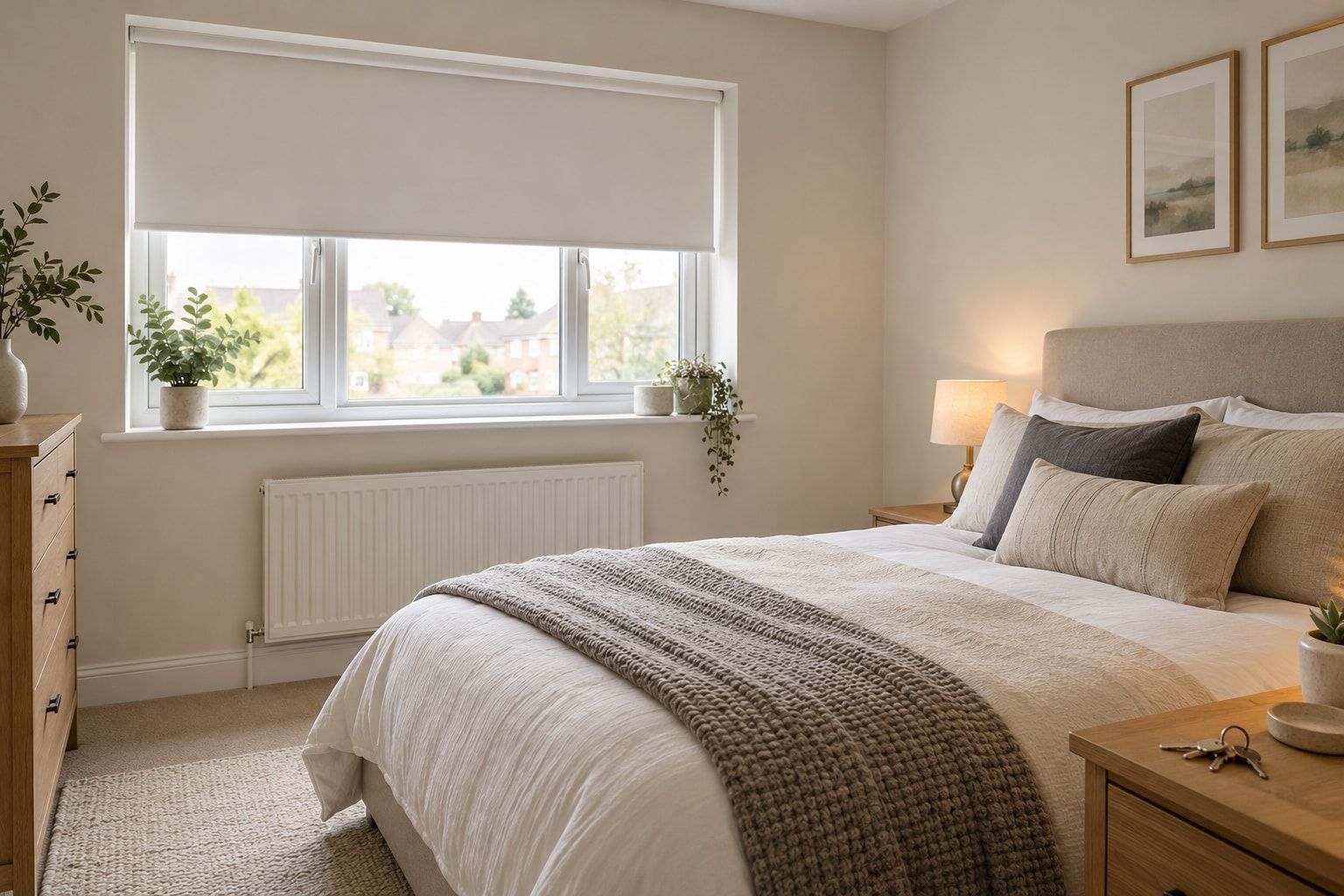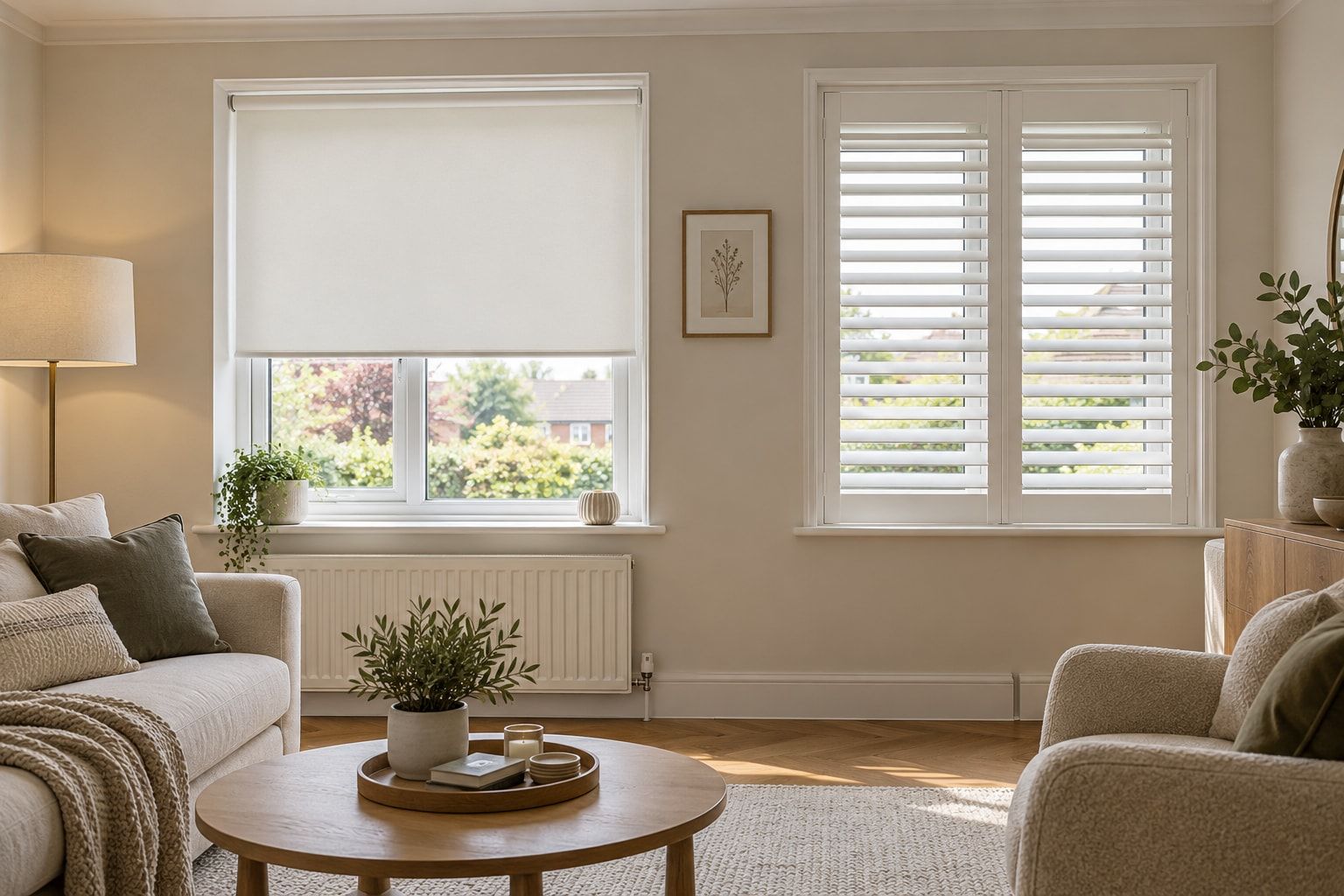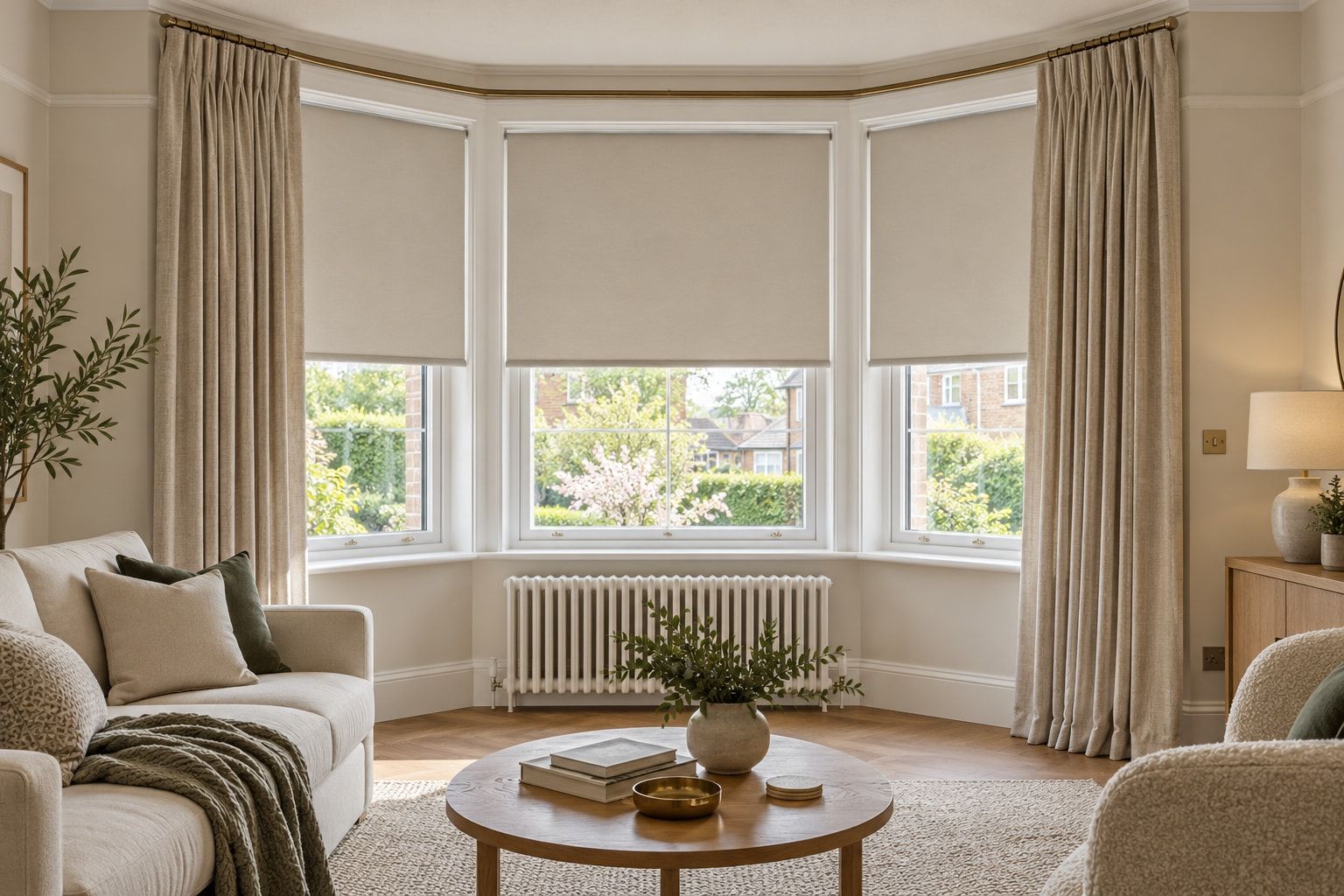
A bay window is often the best feature in a room. It brings in light from several directions, makes the room feel bigger and gives you a lovely spot for a chair or a window seat. You’ll find bays in many of the Victorian and Edwardian terraces and 1930s semis across Birmingham and the West Midlands, as well as in plenty of newer homes.
They can also be one of the trickiest windows to dress. Several panes at different angles, a curve that rules out a straight pole, a radiator underneath, a front window that faces straight onto the street: each of these changes what works. Here’s how to approach it, with the honest pros and cons of each option.
First, know your bay
Before choosing anything, it helps to know which type of bay you have.
- Angled bays are the type we see most often. A wide centre window sits between two narrower side windows, set at an angle.
- Square or box bays have side windows set at right angles to the centre window.
- Curved or bow windows follow a gentle curve, usually with several narrower panes.
It’s also worth noting what’s around the window. Is there a radiator or window seat underneath? Do the windows open inwards? How much wall is there either side of the bay, and how much space between the top of the window and the ceiling? All of these affect what will fit and how it will work day to day.
Option 1: a blind in each window
A very common approach is a separate blind for each window in the bay. Each one is made to measure and fitted in line with its neighbours, so the bay looks tidy from inside and from the street.
Almost any style of blind can work:
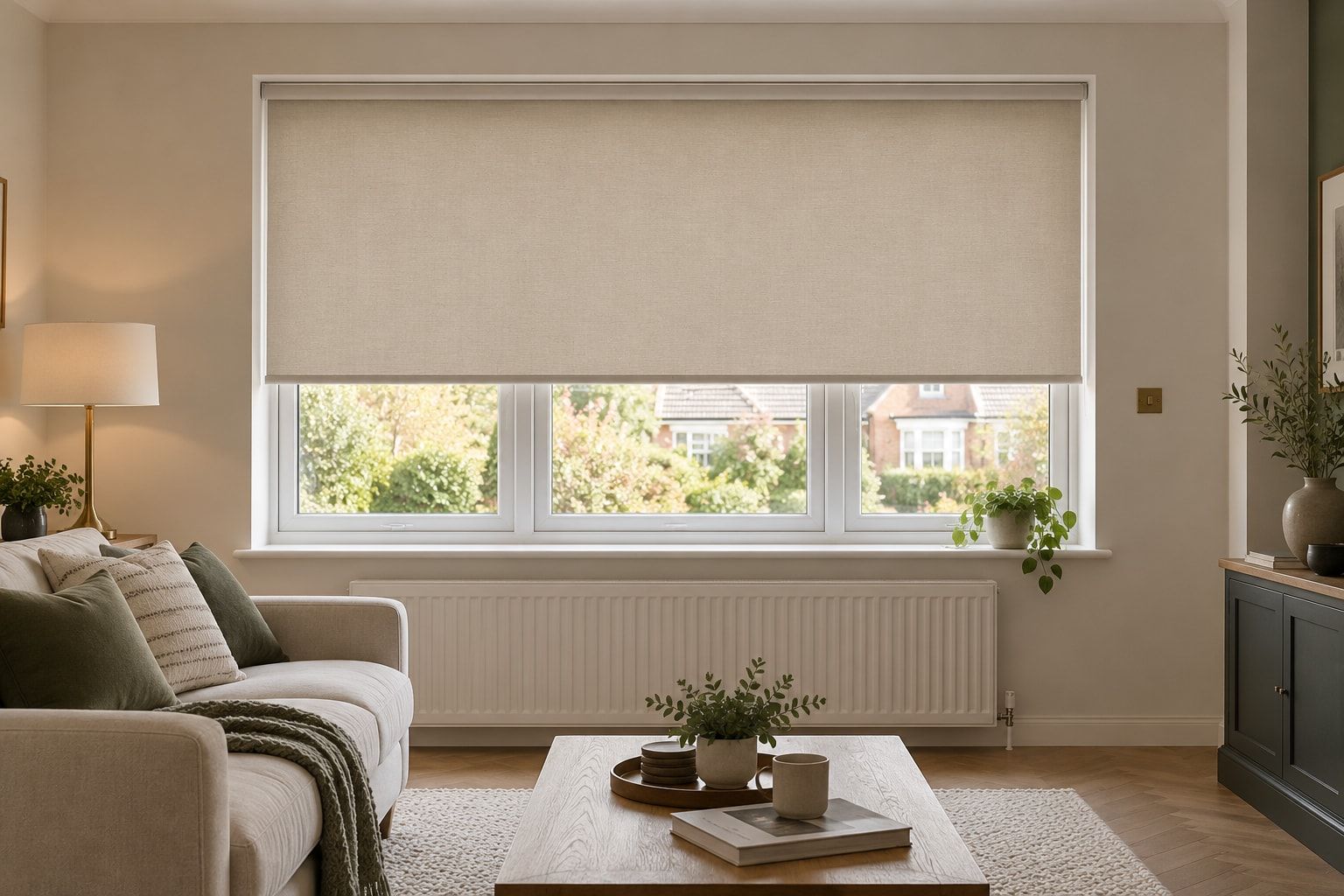
- Roller blinds are slim and simple, and roll up neatly out of the way.
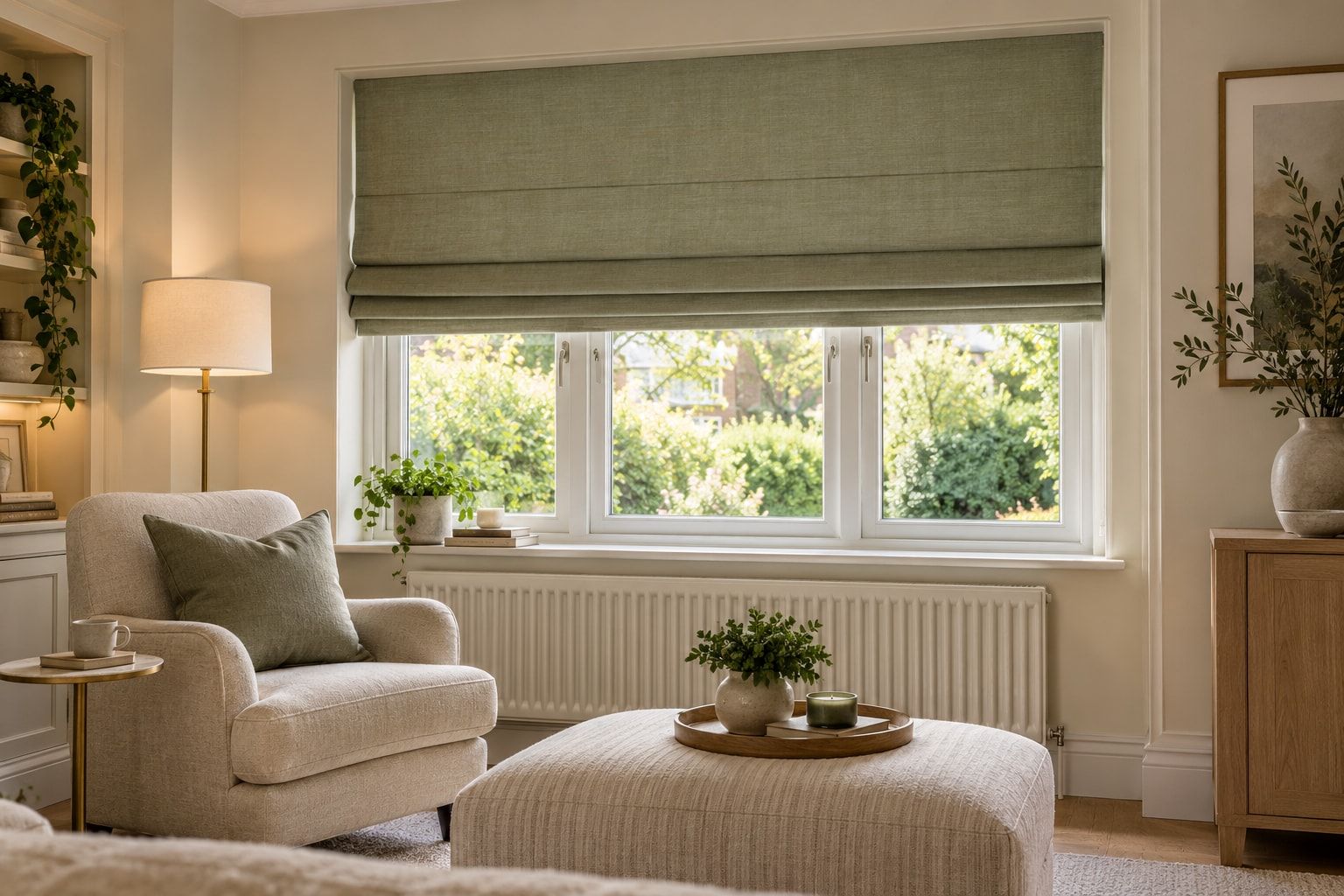
- Roman blinds bring softness, and suit traditional bays beautifully.
- Wooden and faux wood Venetian blinds give you precise control over light.
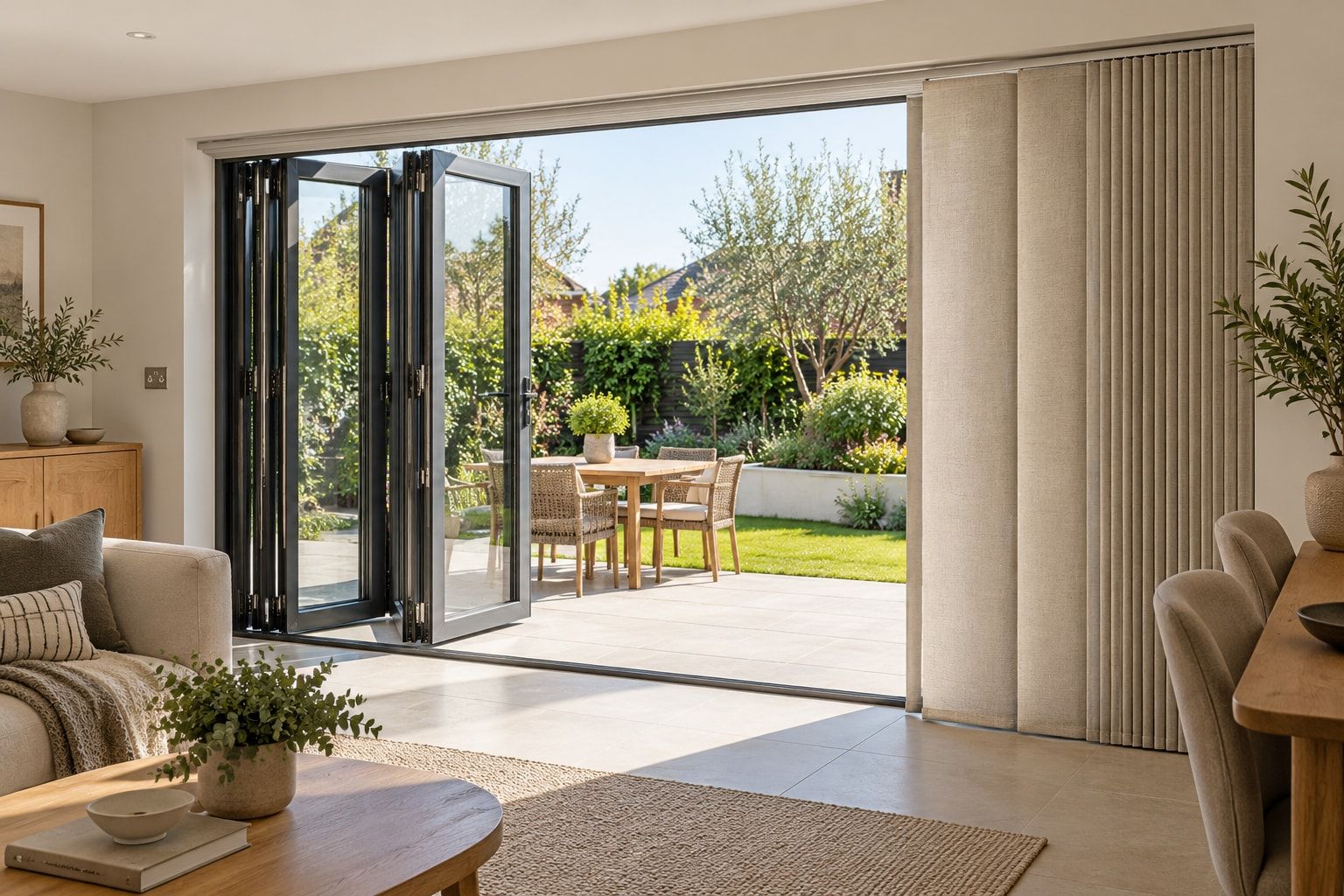
- Vertical blinds are a practical choice across wider bays.
What to think about
The corners. Where two windows meet at an angle, the blinds need to sit close together without catching each other. Careful measuring keeps the gap small, but you’ll usually see a sliver of light at each corner. That’s normal for any blind in a bay.
Roman blinds in tight angles. Romans need more depth than rollers, so in a narrow angled bay the folds can clash at the corners. We check this when we measure, and if it won’t work well, we’ll tell you and suggest an alternative.
Several blinds to operate. With three or more blinds, you’ll raise and lower each one separately. Most people find that’s no trouble at all, and it means you can shade just one side of the bay as the sun moves round.
Option 2: shutters
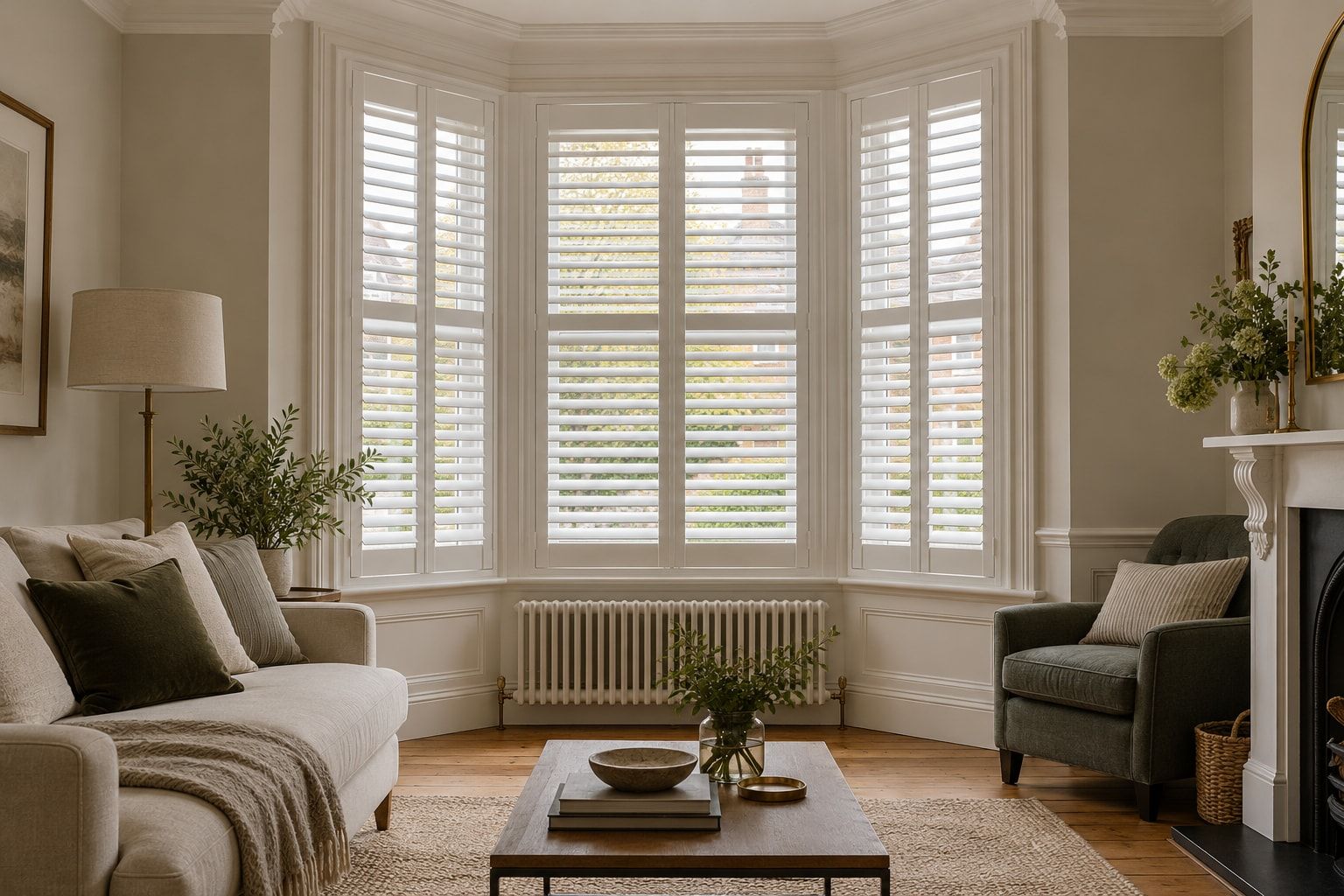
Full-height shutters give a bay a smart, built-in look that’s hard to match. Each window in the bay gets its own shutter panels, made to follow the angles, and the louvres tilt to control light and privacy without opening the panels.
They’re especially good for street-facing front rooms, where privacy matters. Tier-on-tier shutters take this a step further, because the top and bottom halves open independently. You can keep the lower half closed for privacy and open the top to let the light in. Café-style shutters, which cover just the lower part of the window, are a lighter-touch answer to the same problem.
What to think about
- Space to open. Shutter panels swing into the room, so they need clearance from window seats, furniture and window handles. We check this carefully when we measure.
- Light. Even fully open, the frames and panels take up a little of the glass, so shutters let in slightly less light than a fully raised blind.
- Curved bays. On a gentle curve, shutters are usually made as a series of flat panels that follow the line of the window as closely as possible. Whether that looks right depends on the window, and we’ll give you an honest view at your visit.
Option 3: curtains on a bay track or pole
Curtains are the classic way to dress a bay. They hang from a bay track or pole that follows the shape of the window.
- Bay tracks are bent to follow the exact shape of the bay, including curves. They’re slim and discreet, and let the curtains glide smoothly round the corners.
- Bay poles use angled joints at each corner. They make more of a feature, and suit angled and square bays.
Made-to-measure curtains also give you the chance to add a thermal or blackout lining. With glass on three sides, a bay can be one of the coldest parts of a room, and lined curtains help it feel much cosier on winter evenings.
What to think about
- Where the curtains go when open. Curtains need space to stack back. If there’s wall either side of the bay, they can sit there, clear of the glass. If not, they’ll sit across the corners of the bay, which is often fine and can frame it nicely.
- Radiators. If there’s a radiator under the window, floor-length curtains will hang over it and trap the heat behind them. Sill-length curtains, or curtains hung straight across the front of the bay rather than inside it, can solve this.
- Heading style. Some curtain headings run more smoothly round bends than others. We’ll recommend one that suits your track and your bay.
Option 4: blinds and curtains together
In bedrooms and living rooms, layering often gives you the best of both. Blinds in each window handle daytime privacy and light, while curtains draw across in the evening for warmth and a finished, cosy feel. A pale, light-filtering blind with heavier lined curtains in front is a particularly good combination, especially in a bedroom that needs to be dark at night.
Comparing the options
| Option | Best for | Things to consider |
|---|---|---|
| A blind in each window | Everyday light control and practical rooms | Small gaps at the corners, and each blind is operated separately |
| Full-height shutters | A smart, built-in look and privacy in street-facing rooms | Panels need room to open and take up a little of the glass |
| Tier-on-tier shutters | Privacy below with light above | The same clearance checks as full-height shutters |
| Curtains on a bay track or pole | Softness and warmth | Need space to stack back, and care around radiators |
| Blinds and curtains together | Bedrooms and colder rooms | Two products to choose and plan around each other |
A few tips from our fitters
- Think about the street. Front bays are on show. Matching blinds or shutters across every window look neat from outside, and light-filtering fabrics give daytime privacy without making the room gloomy.
- Think about the sun. Bays catch light from different directions through the day. Separate blinds let you shade one window and leave the others open.
- Think about the window seat. If you have one, blinds that sit in the recess keep it free to use, while long curtains will hang in front of it.
- Think about the whole room. A bay is usually the focal point, so it’s worth choosing colours and fabrics that work with the rest of the room rather than in isolation.
Every bay is different, and the right answer often becomes clear once someone has looked at it in person. Book a free home visit and we’ll measure your bay carefully, bring samples of blinds, shutters and curtain fabrics, and talk you through the options honestly. Fitting is included in your quote.
Questions
Can you fit one blind across a whole bay window?
Not a single flat blind, because the windows in a bay sit at different angles. Instead, each window gets its own blind, made so they line up neatly and sit close together at the corners. If you'd like to cover the whole bay in one sweep, curtains on a bay track or pole are the way to do it.
Can I have shutters and curtains in the same bay?
Yes, and it's a lovely combination in bedrooms. The curtains hang on a pole or track above the shutters and draw back clear of them, so the shutter panels can still open freely. We'll plan the spacing when we measure.
Do I need a home visit to measure a bay window?
We'd always recommend it. The angles in a bay make accurate measuring especially important, so that blinds or shutters meet neatly at the corners. Our home measure and quote are free, with no obligation.