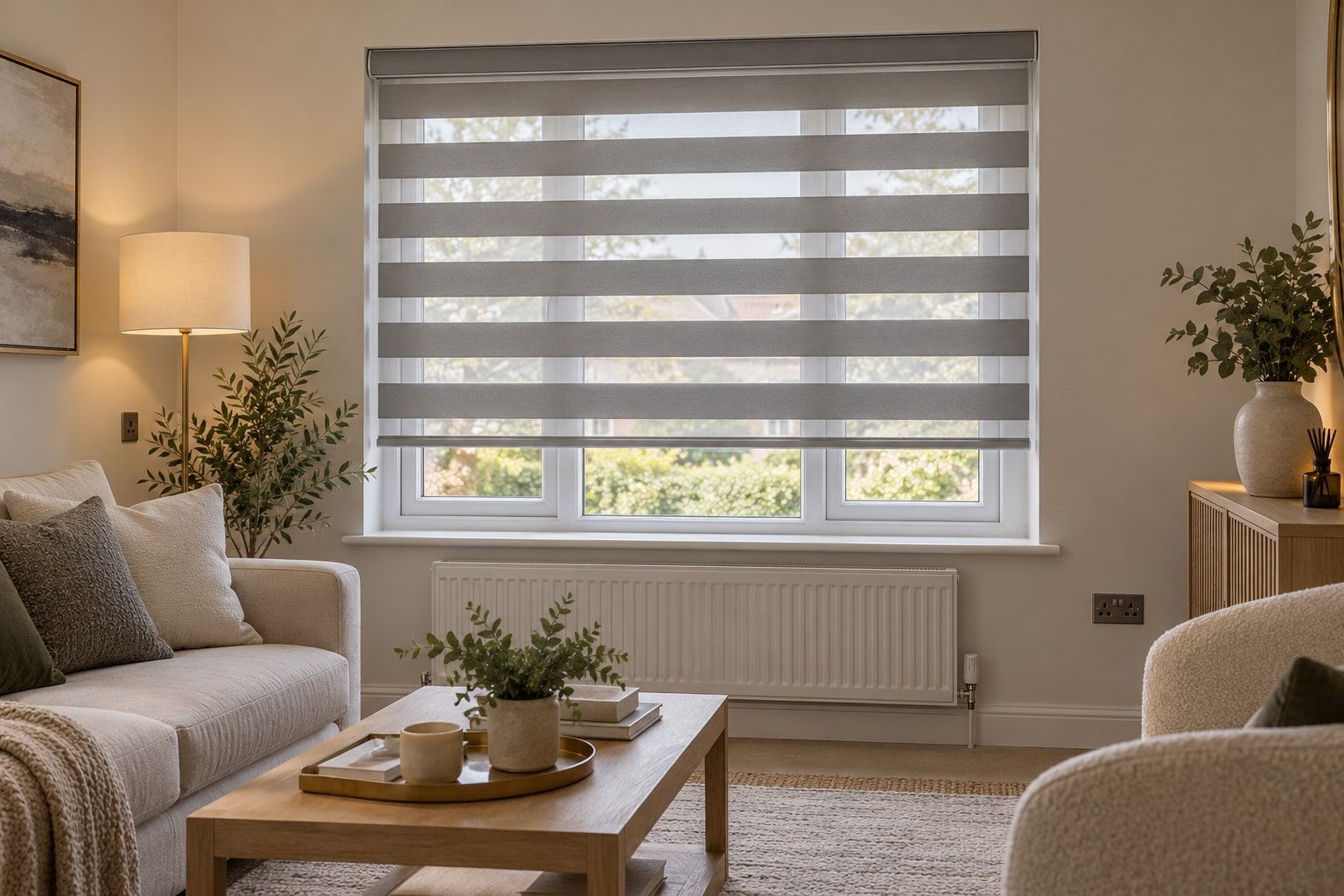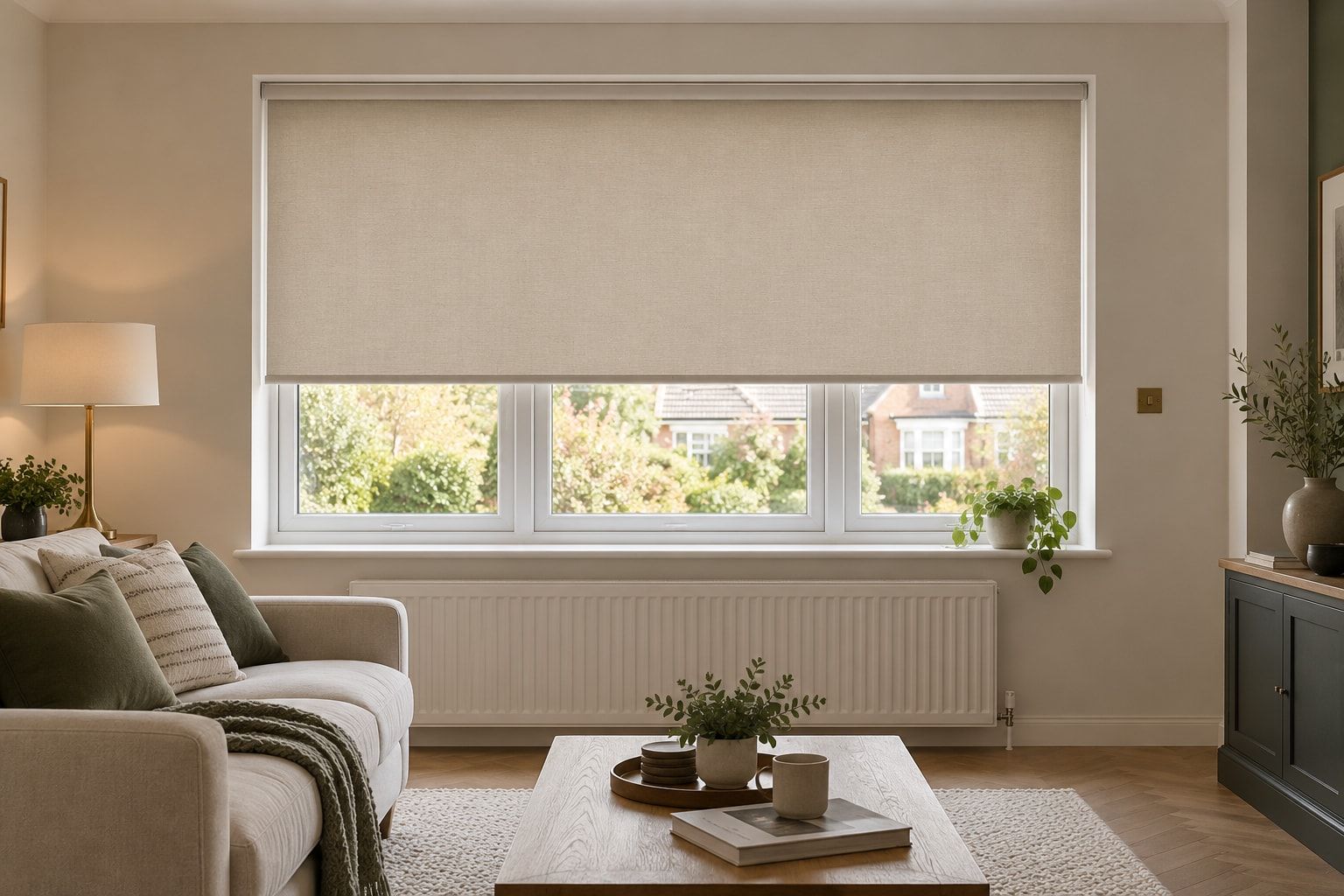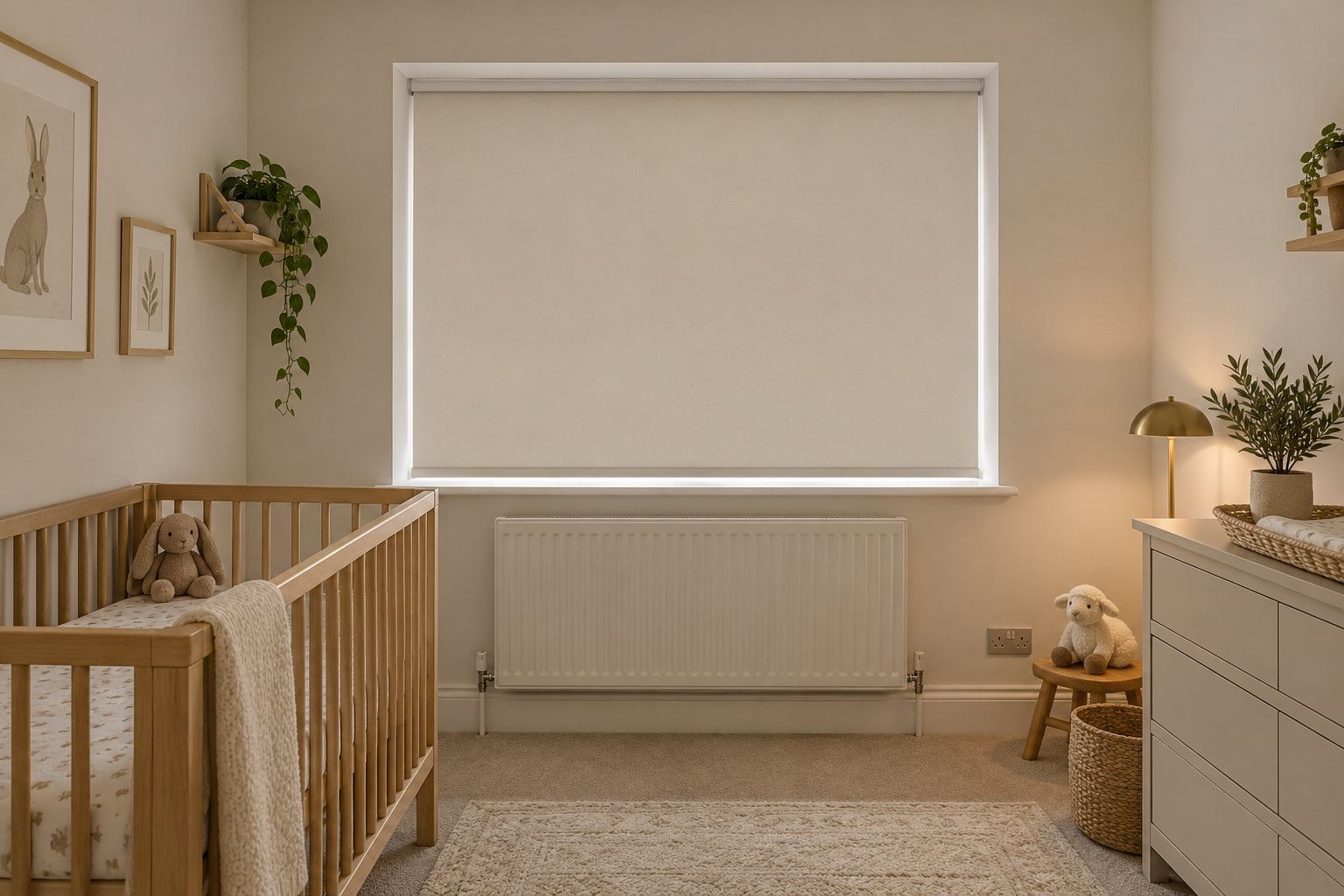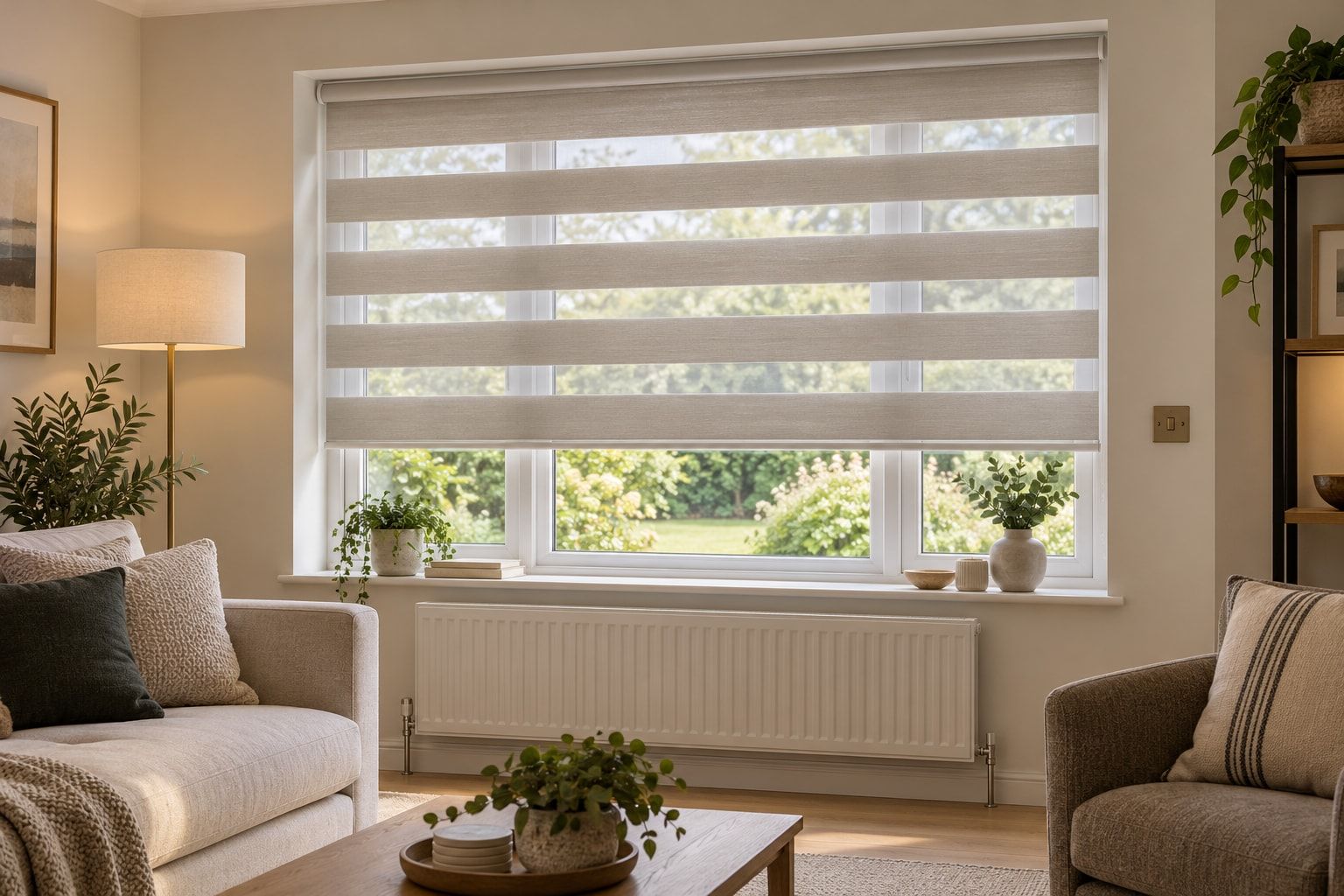
Day and night blinds, sometimes called zebra blinds, are one of the cleverest ideas in window dressing. One blind gives you soft, filtered daylight with privacy during the day, and a solid cover in the evening, without needing a net curtain or a second blind. They’ve become a popular choice for living rooms, bedrooms and home offices.
They aren’t right for every window, though. Here’s how they work, what they do well, where they fall short, and how they compare with the alternatives.
How day and night blinds work
A day and night blind is made from a single length of fabric with alternating horizontal bands: sheer, see-through stripes and solid, opaque ones. The fabric runs in a continuous loop. It comes down from the roller at the top, passes around the bottom bar and goes back up, so there are always two layers hanging in front of the window.
When you operate the blind, the two layers move past each other, and that’s the clever part.
- Bands aligned (open). The sheer stripes on the front sit over the sheer stripes on the back. Light comes through and you get a soft, hazy view of the outside.
- Bands offset (closed). The solid stripes on one layer cover the sheer stripes on the other. The blind becomes a solid panel for privacy and a dimmer room.
- Anywhere in between. Small adjustments change how much light comes in.
You can also raise the blind fully, just like a roller blind, when you want the whole window clear.
What they do well
- Privacy with daylight. In the daytime, with the bands open, it’s hard for people outside to see in, but you still get plenty of light. That makes them ideal for street-facing rooms.
- One blind instead of two. They do the job of a net curtain and a blind together, which keeps the window looking clean and uncluttered.
- Fine control. A small adjustment changes the light, so you can cut glare on a TV or computer screen without shutting out the day.
- A modern look. The neat horizontal stripes suit contemporary rooms, and there’s a good range of colours, from crisp whites and soft greys to warmer naturals.
- Neat when raised. Like a roller blind, it tucks away at the top of the window.
The honest drawbacks
- They aren’t blackout. Even fully closed, some light comes through between the bands and around the edges. If you need a properly dark bedroom, a blackout blind is the better choice.
- Close them after dark. At night, with the lights on inside, the sheer bands become see-through from outside, just like a net curtain. Set the blind to closed in the evening for full privacy. That’s what the “night” part is for, but it’s worth knowing.
- A bulkier roll. Because there are two layers of fabric, the roll at the top is larger than on a standard roller blind. A shallow recess may mean fitting the blind outside it. We check this when we measure.
- Not for wet areas. They’re made from fabric, so they don’t belong right above a sink or in a steamy bathroom.
How they compare
| Day and night blind | Roller blind with voile | Venetian blind | Standard roller blind | |
|---|---|---|---|---|
| Daytime privacy with light | Yes, through the sheer bands | Yes, through the voile | Yes, by tilting the slats | Partly, with a light-filtering fabric |
| Night-time privacy | Yes, when closed | Yes, with the roller down | Yes, with the slats closed | Yes |
| Can make a room dark | Dim, not blackout | Yes, with a blackout roller | Dim, with light round the slats | Yes, with a blackout fabric |
| Look | Modern and striped | Soft and layered | Crisp, with a wood finish | Clean and simple |
| Items at the window | One | Two | One | One |
Day and night versus a roller blind with a voile
A roller blind paired with voiles gives a similar day-and-night effect. The voile gives you daytime privacy and the roller goes down at night. It has a softer, more layered look, and you can choose a blackout roller for a darker room. The trade-off is two things at the window instead of one.
Day and night versus a Venetian blind
Wooden and faux wood Venetian blinds also give you privacy and light at the same time, by tilting the slats. They have a warmer, more traditional feel, and faux wood copes better with steam. Day and night blinds are softer to look at and have fewer surfaces to dust.
Day and night versus a standard roller blind
A standard roller blind is simpler, and you can choose any light level from light-filtering to blackout. What it can’t do is switch from filtered light to full privacy without being raised or lowered. If you usually leave a roller blind half down during the day for privacy, a day and night blind is likely to suit you better.
Where they work best
- Living rooms facing the street, where you want daylight without feeling on show.
- Home offices, where you need to cut screen glare but don’t want to work in the dark.
- Bedrooms that don’t need total darkness, such as guest rooms.
- Ground-floor flats and bungalows, where privacy matters at every window.
- Kitchen-diners, at windows away from the sink and hob.
They’re less suited to steamy bathrooms, windows directly above a sink, and bedrooms that need to be properly dark.
Choosing fabric and fit
Our day and night blinds are made to measure, and when we visit we bring a range of fabrics so you can see how each one behaves in your own light. A few things to think about:
- Colour. Lighter shades keep a room feeling bright and airy. Deeper shades make more of a statement and can look striking in a modern space.
- How sheer the open bands are. Fabrics vary, which changes how much of the view you see and how private the room feels in the daytime.
- Inside or outside the recess. Inside gives a neat, built-in look. Outside suits shallow recesses and helps cut light round the edges.
- Operation. We’ll show you how the blind is raised, lowered and adjusted, and make sure the controls are on the side that’s easiest for you to reach.
Made to measure matters more with day and night blinds than with most. The bands need to roll evenly to stay level and line up properly, and a blind made to the exact width of your window does that far better than an off-the-shelf size.
See one in action
The best way to understand a day and night blind is to see one move. Book a free home visit and we’ll bring samples to your home, show you how the bands work, and measure up with no obligation. Fitting is included in your quote, and if another style would suit a particular window better, we’ll tell you.
Questions
How do I clean a day and night blind?
Dust it regularly with a soft brush, or a vacuum cleaner on a low setting with the brush attachment. Small marks can usually be dabbed gently with a slightly damp cloth. Don't soak the fabric or use strong cleaners.
Are day and night blinds child-safe?
Yes. Like all our blinds, they meet the UK child-safety standard (BS EN 13120), and any chain is secured with a child-safe tensioner.
Can I have day and night blinds in a bay window?
Yes. Each section of the bay gets its own made-to-measure blind. Set them all to the same position for a neat, even look across the whole bay.